


Keyword research is the backbone of effective SEO, and Ahrefs makes it easier than ever to uncover the terms your audience is actually searching for. Instead of relying on guesswork, Ahrefs provides real data like search volume, keyword difficulty, Backlinks and traffic potential, which helps you choose the right keywords to target.
In this guide, we’ll walk through how to use Ahrefs Keyword Explorer step by step, so you can build a content strategy that drives meaningful results.
What is Keyword Research and Why Do It for SEO?
Keyword research is the process of finding the words and phrases people use when searching for information, products, or services online. It helps you understand what your target audience is looking for so you can create content that matches their needs.
For SEO, keyword research is important because it helps you target topics with real search demand, improve your chances of ranking in search results, and attract relevant visitors to your website. Without keyword research, you may create content that people are not actively searching for.
How Ahrefs Helps with Keyword Research?
Ahrefs helps with keyword research by providing accurate SEO data that allows you to understand what people are searching for and how competitive those searches are. It does it with the help of its Keyword Generator tool.
This tool quickly expands a single seed keyword into a wide range of related keyword ideas along with key metrics like search volume, keyword difficulty, and clicks, helping you identify opportunities worth targeting.
What is Ahrefs Keyword Explorer?
Ahrefs Keyword Explorer is a powerful SEO tool designed to help users find relevant keywords to target in their content strategy.
It provides detailed data such as search volume, keyword difficulty, and potential traffic to help you prioritize keywords that can improve your website’s performance in search engines. This makes it ideal for SEO beginners looking to understand which keywords can effectively attract their target audience.
Why Use Ahrefs Keyword Generator Tool?
Ahrefs offers accurate and detailed keyword metrics that many large language models and AI tools cannot provide, such as actual search volume and competition level.
While AI can suggest keyword ideas, Ahrefs helps validate them with real data to avoid “screaming into a void.” This ensures that you target keywords that have genuine search demand, improving your chances of ranking and drawing qualified visitors.
How to Use the Ahrefs Keyword Checker Tool for Free?
You don’t need a paid plan to start exploring keywords for the first time because Ahrefs provides free tools that make it easy to begin your research.
Here are the steps:
Step 1: Visit Ahrefs Keyword Generator
Start by visiting Ahrefs’ Keyword Generator tool. This feature allows you to input a broad topic or phrase and generate a list of keyword ideas related to your niche.
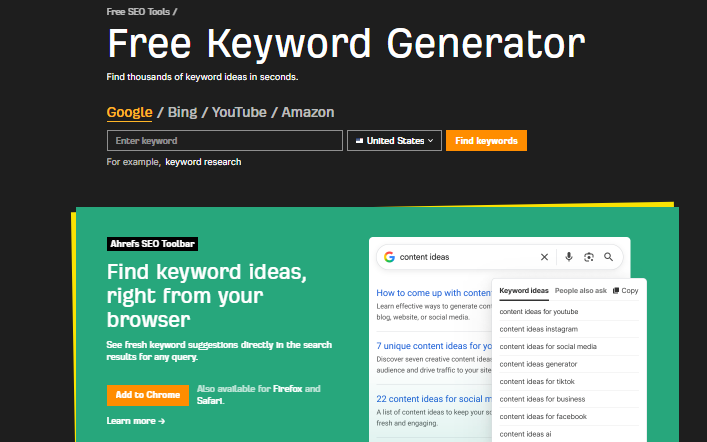
It’s a simple starting point for beginners to uncover potential search terms relevant to their content.
Step 2: Type Your Target Keyword
Next, enter the primary keyword you want to research. For example, if your topic is “travel tips,” type this into the keyword density checker so it can find associated keywords that users frequently search.
Step 3: Choose Your Target Location Keyword
Select the geographic location for keyword research, such as the country or region you want to target. This helps you obtain search volume and competition data tailored to your target market, making your SEO strategy more localized and relevant.
Step 4: Click Find Keywords
Click the “Find Keywords” button to generate a list of relevant keywords with essential metrics like monthly search volume, keyword difficulty (how tough it is to rank), and potential click volume. This helps you evaluate which keywords have high potential and fit your SEO goals.
A Step-by-Step Guide to Using Ahrefs Keyword Explorer for SEO
To get the most out of Ahrefs, it helps to follow a clear process. Here’s a simple guide to using Keyword Explorer effectively.
Research The Topic
Begin by researching your topic to understand the industry, audience needs, and general keyword themes. This background knowledge will guide your keyword selection.
Start with the main keyword
Use a broad or “seed” keyword in Ahrefs Keyword Explorer as your starting point. This will help you discover related keywords, including long-tail variants that might be easier to rank for.
Analyze Metrics
Pay close attention to key metrics, including:
- Search volume: How many searches a keyword gets monthly.
- Keyword difficulty: The competitiveness of the keyword.
- Clicks: The potential number of clicks from ranking for the keyword.
Analyzing these helps you prioritize keywords that balance traffic potential with achievable ranking difficulty.
Export Keywords That Are Relevant to your Niche
Export the list of keywords that closely align with your niche or business area. This organized data can further inform your content calendar and SEO plan.
Use Keywords Competitors
Leverage Ahrefs’ competitor analysis features to see which keywords your competitors are ranking for. This can reveal untapped keyword opportunities or niches where you can compete strategically.
Monitor Keywords and Update Content
Keyword research is an ongoing process. Continuously monitor your keywords’ performance and update your content to keep it relevant and in line with search trends.
Benefits of Using Ahrefs Keyword Tool
Beyond keyword discovery, Ahrefs provides several advantages that can strengthen your overall SEO strategy. Here are some benefits of using Ahrefs keyword tool:
- Provides real search volume and competition data.
- Helps identify keywords competitors use.
- Offers insights into keyword difficulty and click potential.
- Facilitates export and organization of keyword data for efficient SEO planning.
- Supports ongoing monitoring to keep SEO efforts agile and up-to-date.
Quick Pro Tips for Better Keyword Research
Keyword research works best when you focus on strategy instead of just collecting random keywords. A few simple habits can make your results much more effective.
- Start with broad seed keywords, then narrow them into long tail keywords with lower competition
- Focus on keywords with clear search intent instead of only high search volume
- Check keyword difficulty before targeting any term to avoid highly competitive topics
- Look at competitor keywords to find gaps you can target
- Group similar keywords together and use them in one content piece instead of spreading them out
- Update your keyword list regularly as trends and search behavior change
Common Mistakes to Avoid as a Beginner
Beginners often make simple keyword research mistakes that can reduce their chances of ranking and waste time on the wrong topics. Avoiding these issues early helps you build a stronger SEO strategy.
- Targeting only high-volume keywords without checking the competition level
- Ignoring search intent and writing content that does not match what users want
- Using too many unrelated keywords in one article instead of focusing on one topic
- Not analyzing competitor keywords before choosing your own
- Relying only on free keyword ideas without checking real data or difficulty
- Failing to update or improve keyword research over time as trends change
Ahrefs Pricing
Before deciding which plan to use, it’s important to understand the pricing options Ahrefs offers. Here are its pricing details:
Lite: $129/mo
Standard: $249/mo
Advanced: $449/mo
Enterprise: $1.499/month.
Is using Ahrefs ’ free keyword research tool worth it?
Yes, Ahrefs’ free keyword tools are worth using for beginners or quick research. The Keyword Generator lets you enter a seed keyword like “travel tips” and instantly shows related keyword ideas along with basic metrics such as search volume ranges, keyword difficulty, and clicks.
It’s especially useful for finding long-tail keywords like “cheap travel tips for students” that are easier to rank for. However, it has limits. You won’t get full data depth, advanced filtering, or full SERP insights like in the paid version, so it’s best for idea generation rather than full SEO planning.
Ahref’s Free Vs Paid Keyword Research Tool
| Feature | Free Keyword Tools | Paid Ahrefs Keyword Explorer |
| Keyword suggestions | Limited keyword ideas (basic generator) | Full keyword database with millions of suggestions across countries |
| Search volume data | Approximate ranges only | Exact monthly search volume with deeper historical data |
| Keyword difficulty (KD) | Basic difficulty indicators (simplified) | Advanced KD score with competitor backlink analysis |
| Click metrics | Not available | Shows estimated clicks and CTR potential |
| SERP analysis | Very limited (basic overview only) | Full SERP breakdown with competing pages |
| Competitor keyword research | Not available | Full competitor keyword + traffic analysis |
| Filters & sorting | Minimal | Advanced filters (volume, KD, intent, CPC, etc.) |
| Export options | Very limited or none | Full export of keyword lists for SEO planning |
| Best use case | Beginners and idea generation | Professional SEO strategy and content planning |
Should You Buy the Paid Version?
Yes, you should buy the paid version of Ahrefs if you are serious about SEO and need accurate data for growth. It gives exact search volumes, keyword difficulty, competitor analysis, and full SERP insights that help you build a strong SEO strategy.
It is best for bloggers, agencies, and businesses that rely on organic traffic. However, if you are just starting out or only doing basic research, the free tools are usually enough.
Google Keyword Planner vs Ahrefs: Which is Better?
Google Keyword Planner is free and useful for basic keyword volume data but lacks deeper competiton and click potential insights. Ahrefs provides a richer set of data, including metrics that help you understand keyword competitiveness and traffic potential. For beginners, combining both tools can be beneficial, but Ahrefs is generally better suited for more comprehensive SEO research.
Final Thoughts
Conducting keyword research with Ahrefs Keyword Explorer is essential for developing a strong SEO strategy. It helps you uncover keywords that your audience is actually searching for while giving you the data needed to prioritize efforts effectively. Remember, keyword research is iterative, keep analyzing, updating, and refining your keyword list over time. If you want expert help, consider consulting a reliable SEO service company to guide your efforts professionally.
This summary uses data from the references provided above to outline how to conduct keyword research using Ahrefs effectively. If you want a practical, data-driven approach to keyword research, Ahrefs is a powerful choice, especially when complemented with sound SEO principles.
Frequently Asked Questions (FAQs):
Yes, Ahrefs offers an easy-to-use interface with comprehensive data, suitable for beginners who want to learn in-depth keyword research.
Yes, you can start your research using the free Google Keyword Planner, but the results will not be as comprehensive as Ahrefs.
It is best to update your keyword research regularly, at least every 3-6 months or when there are changes in trends in your industry.
Use relevant keywords with good search volume to create content that addresses your audience’s needs and optimizes your website’s SEO.
